Episode Summary
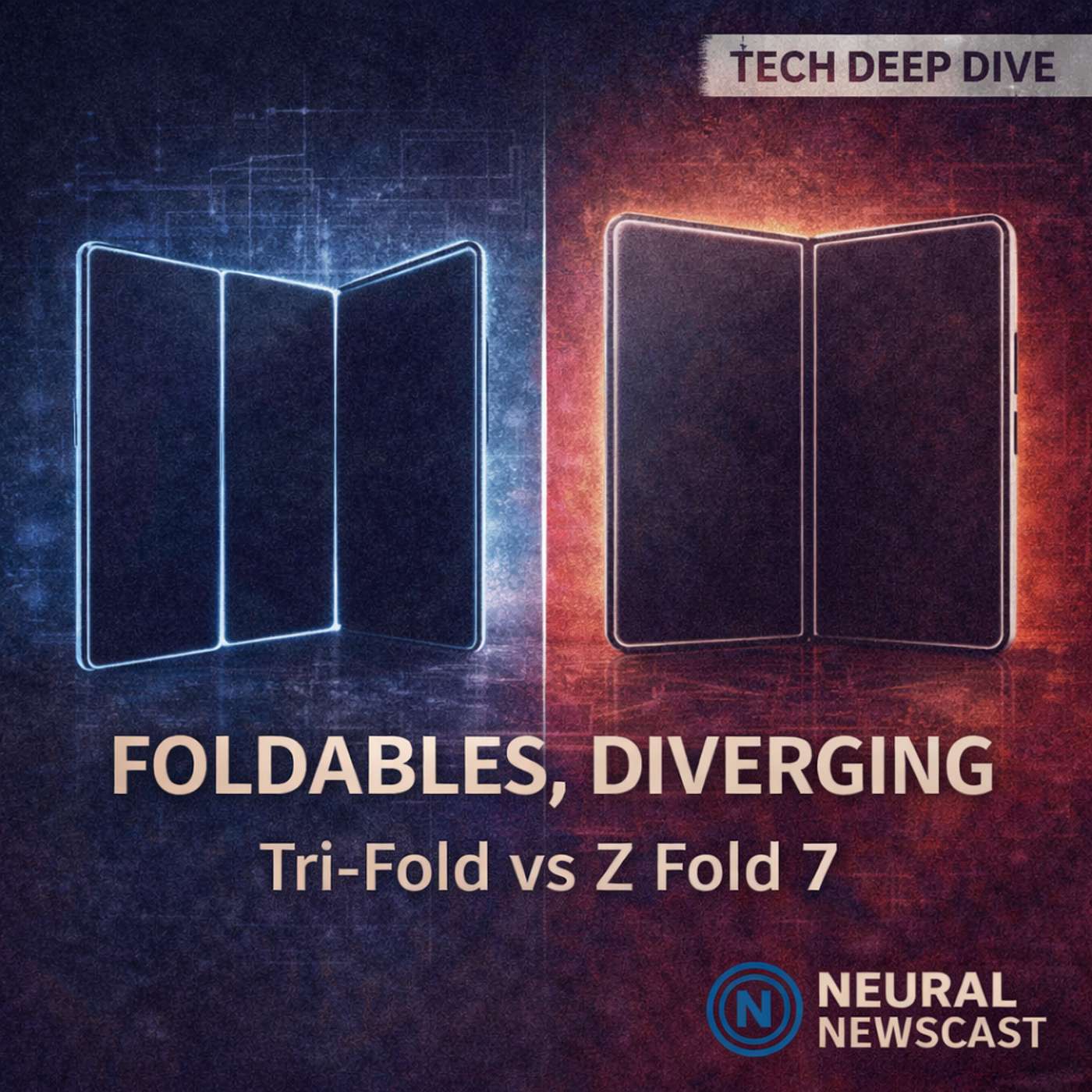
Samsung’s new foldables show two distinct philosophies: a tri-fold concept that prioritizes maximum screen real estate and a Z Fold 7 that refines the familiar book-style fold. Here’s what feels meaningfully different in hand, and what it could mean for the next wave of foldable phones.
Show Notes
Samsung is pushing foldables in two directions at once: a more experimental tri-fold design that aims for a larger tablet-like canvas, and an updated Z Fold 7 that focuses on polish and practicality. In today’s episode, we break down how they differ based on hands-on impressions and what these choices signal about where foldables are headed.
- 📱 What a tri-fold changes about portability, grip, and daily use
- 🧩 How the Z Fold 7 builds on the book-style formula people already know
- 🪟 The cover-screen experience versus the big-screen experience
- 🔍 The tradeoffs that matter most: thickness, durability, and usability
- 🧠 What Samsung’s split strategy suggests about the future of foldables
Neural Newscast is AI-assisted, human reviewed. View our AI Transparency Policy at NeuralNewscast.com.
Transcript
Full Transcript Available
From Neural Newscast, I'm Tessa Quinn. Today we're kind of stepping into the hinge lines and the seams of Samsung's foldable future because CNET just drops some hands-on impressions comparing two really different ideas of what a foldable should be, the Galaxy Z Trifold and the Galaxy Z Fold 7. I'm Isaac Doyle. And yeah, think of it like a fork in the road. The Z Fold 7 is the controlled evolution, Samsung's book-style foldable getting a cleaner, more mature version of itself. The trifold is the bolder swing, like a phone that opens again, chasing a bigger display and a different way to move between phone and tablet. Let's start with how it feels, because foldables always live or die in the hand, right? The trifold's headline is pretty simple, more screen. It's the kind of thing that immediately makes you imagine reading long features, sketching, or running two apps side by side without that constant squeeze of cramped space. But that extra screen comes with extra complexity. More folds means more moving parts, more segments to manage, and honestly, more questions about real-world durability. Even before you get into specs, the design itself adds stress points, hinges, creases, and places where grit and pressure can build up over time. Meanwhile, the Galaxy Z Fold 7 is the familiar story just told with a cleaner edit. People understand this rhythm now, a cover screen for quick stuff, and then you open it up into that bigger inner display when you're ready to settle in and do more. And CNET's comparison really points to that core split. The Z Fold 7 feels like refinement, while the trifold feels like ambition. Refinement is what you notice after a week, not a minute, you know. Like how it sits in a pocket, how often you can open it with one hand, how quickly you can bounce from messages to maps to email without fighting the device. And ambition is about the canvas. The trifold is basically trying to turn a phone into a more expansive little stage. It hints at this world where your commute becomes a tiny studio, your notes become a real page, and your videos stop feeling like they're trapped inside a narrow frame. There's also a usability question hiding in plain sight, which is, how do you use it when it's closed? The cover screen experience matters because most people spend a lot of time not fully unfolded. With the Z-fold line, Samsung has years of feedback on that balance. With the trifold, the closed mode and partial open modes create new patterns, and not all of them are going to be instantly intuitive. It's almost like two philosophies of attention. The Z Fold 7 says, here's a phone that can become a bigger screen when you ask it to. The TriFold says, what if the bigger screen is the point? And the phone shape is just how you carry it from one place to another. And that's where the trade-offs start to really matter for buyers. The more elaborate the folding system, the more you have to weigh thickness, long-term reliability, and the reality of using a device in crowded, messy, unpredictable environments. Bigger isn't free. It's paid for in engineering and in compromise. Still, it's pretty exciting to see Samsung showing both at once. One device is for people who want foldables to feel normal, seamless, dependable. The other is for people who want foldables to feel like a new category entirely. This pocket object that, I mean, blooms into a workspace. The signal here feels strategic. Samsung looks like it's testing two futures, one where foldables win by becoming practical, and one where foldables win by becoming kind of irresistible. And the market decides which future feels worth the price, the learning curve, and the maintenance risk. That's today's Neural Newscast. I'm Tessa Quinn. And if you're thinking about a foldable, just remember the most important spec is often the one you can't read on a chart. It's that moment you realize the device fits your life, or it doesn't. I'm Isaac Doyle. And if you want to go deeper, our take here draws from CNET's hands-on reporting on the Galaxy Z Trifold versus the Galaxy Z Fold 7. Subscribe for more and share the show with a friend who's been tempted by foldables. Neural Newscast is AI-assisted, human-reviewed. View our AI transparency policy at neuralnewscast.com.
✓ Full transcript loaded from separate file: transcript.txt
Loading featured stories...