Episode Summary
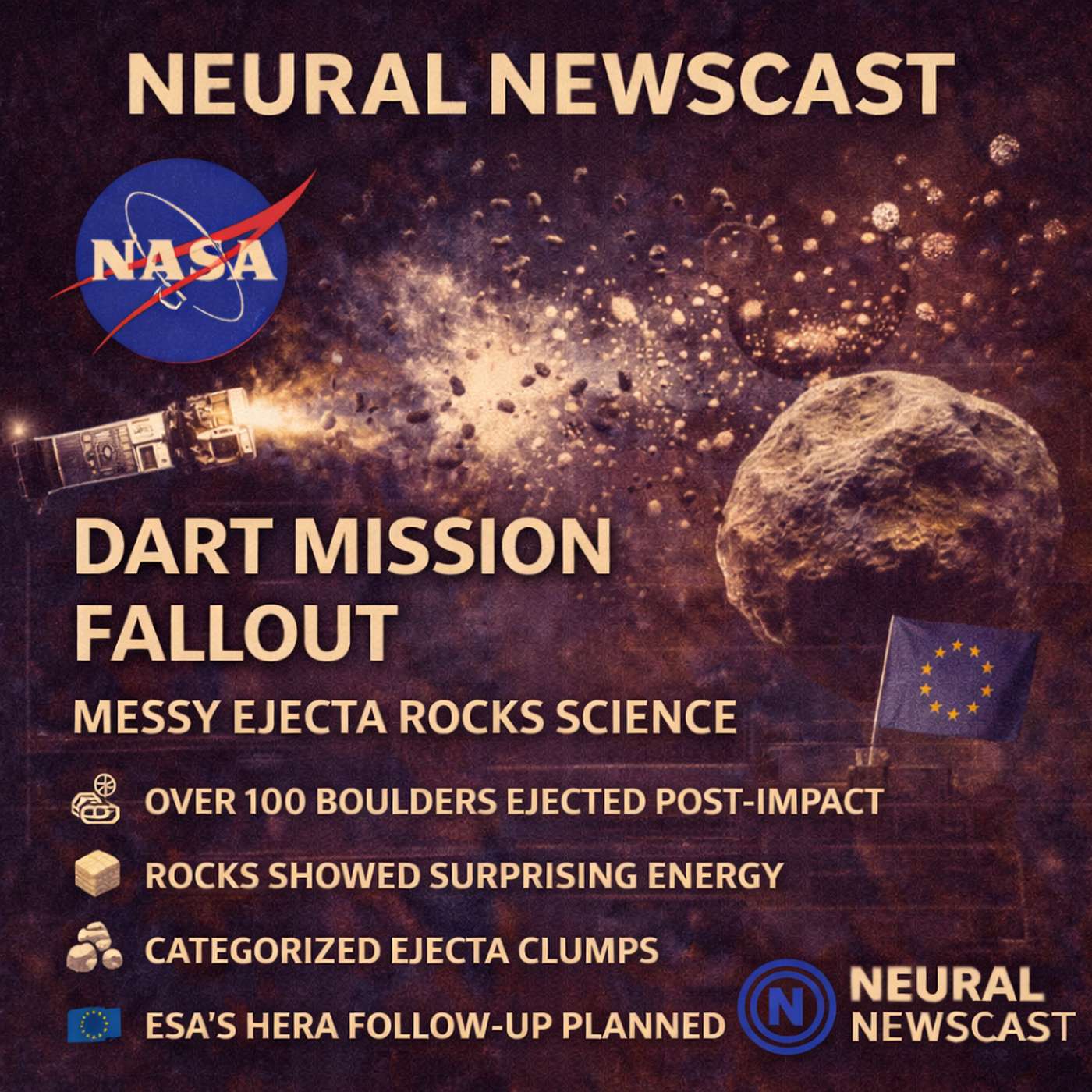
New research suggests NASA’s DART mission changed Dimorphos’ orbit not only through impact, but also through a powerful, uneven spray of ejected boulders. The findings add complexity to how future asteroid-deflection missions may need to be planned and modeled.
Show Notes
NASA’s DART mission proved we can nudge an asteroid—but scientists now say the aftermath was messier, and more informative, than first understood.
- 🛰️ Researchers tracked more than 100 boulders blasted off Dimorphos after the DART impact
- 🪨 Some ejected rocks carried over three times the energy of the spacecraft itself
- 🎱 The debris appears clustered in distinct groups, not scattered randomly
- 🔭 Observations from Italy’s LICIACube helped reveal unexpected ejecta behavior
- 🇪🇺 ESA’s Hera mission is expected to arrive next year for a closer look at the crash site
Neural Newscast is AI-assisted, human reviewed. View our AI Transparency Policy at NeuralNewscast.com.
Transcript
Full Transcript Available
You're listening to Neural Newscast. I'm Lydia Holmes. Today we're revisiting Mass's big, cinematic planetary defense moment, the DART mission, when a spacecraft slammed into an asteroid to prove we could change its path if Earth were ever in danger. I'm Jalen Price. So, in 2022, the double-asteric redirection test hit the small moon-led DeMorphos, which orbits a larger asteroid called Didimos. The impact was about 14,000 miles per hour, and it successfully altered DeMorphos' orbit. And it really sounded like a clean win, right? Hit the target, move the rock, save the planet. But new research says the collision had an extra twist. Because the impact didn't just shove the asteroid. It also launched a barrage of boulders that helped push it too. Yeah. The study, published in the Planetary Science Journal, comes from a team led by the University of Maryland. Their conclusion is, the direct impact changed to Morphos' orbit, but the ejected material added another kick that was almost as big as the impact itself. And when they say ejected material, they mean big pieces. Not dust, not pebbles, actual boulders. Using imagery from Lysi Cube, a small Italian space agency spacecraft that watched the aftermath, the researchers tracked 104 boulders. They ranged from about half a foot to nearly 12 feet in radius, and some carried more than three times the energy of the DART spacecraft itself. That kind of detail makes this feel less like one heroic punch and more like, you know, a chaotic chain reaction, like you hit the cue ball and suddenly the whole table is in motion. That's basically the team's warning. If asteroid deflection is a cosmic cool game, the ejecta, the debris that flies off, can act like extra balls adding forces you didn't plan for. And that changes the physics mission designers have to model before the next real-world emergency. And here's the strange part. The boulders didn't spread out evenly. They clustered into two pretty distinct groups, with an absence of material elsewhere, so the debris pattern looked organized, not random. Right, and the researchers say that suggests something unknown influenced how the material flew off. One hypothesis is DART solar panels struck two large boulders on the surface right before the main body hit, which could have changed how energy transferred and shaped the ejecta into those clustered strains. So, instead of a smooth, predictable surface, demorphos may have been more like a rocky pile with big chunks. And that matters. Because if the surface is uneven, the outcome of a deflection attempt could be uneven too. Exactly. If an asteroid were actually headed toward Earth, you'd need to move it a specific amount in a specific direction on a specific timeline, and small uncertainties can compound. The point isn't that DART failed, it's that future deflection missions have to account for subtleties like surface composition, boulder distribution, and debris recoil. The good news is the story isn't over. Europe's Hera mission is scheduled to rendezvous with the Didimos and De Morphos system next year, and that should give scientists a much closer look at the crash site and its long-term effects. Hera should help confirm how the impact reshaped the asteroid, how much material was displaced, and how that debris contributed to the orbital change. That follow-up is crucial because planetary defense isn't one experiment. It's building a reliable playbook for a scenario we hope never happens. So, yeah, we can move an asteroid. But the new takeaway is when you do it, the asteroid can push back in complicated ways, throwing off debris that adds its own shove. And that complexity is useful. Every detail improves models, improves planning, and reduces uncertainty. The more we understand the full chain of effects, the better the odds that if we ever have to take a real shot, we won't miss the pocket. That's it for this update from Neural Newscast. I'm Lydia Holmes. I'm Jalen Price. If you want more updates like this, follow the show and share this episode with someone who'd be into space science. Neural Newscast is AI-assisted, human-reviewed. View our AI transparency policy at neuralnewscast.com.
✓ Full transcript loaded from separate file: transcript.txt
Loading featured stories...